
Free TDEE Calculator — Precision Metabolism Metrics
Master your metabolism with our professional-grade calculator. Get instant, lab-accurate results for TDEE, BMR, and Macros.
TDEE Calculator Form
Biometric Inputs
Enter your current physiological metrics for the calculation engine.
TDEE Calculator Results
Metabolic Profile Awaiting Data
Please fill out the form above to activate the calculation engine and view your results.
What is TDEE and Why It Matters for Your Fitness
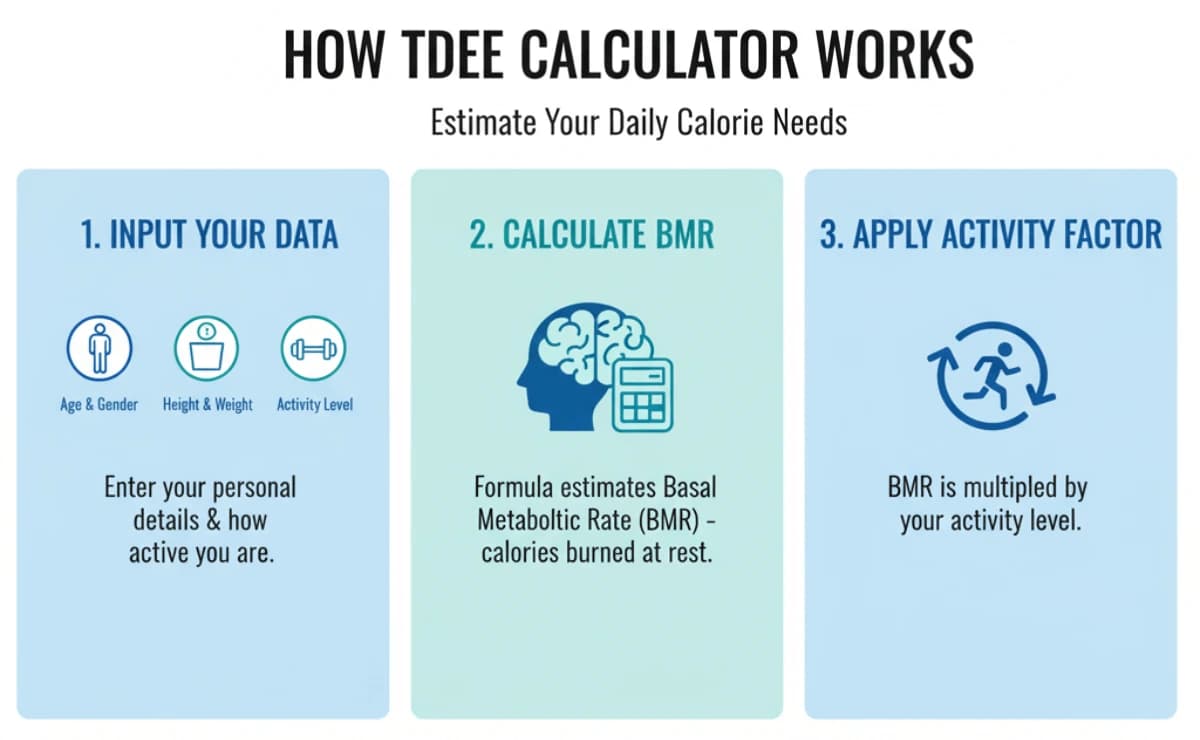
TDEE stands for Total Daily Energy Expenditure. It is the total number of calories your body burns in a 24-hour period, including all activities—from sleeping and breathing to intense exercise. Understanding your TDEE is the most critical first step in taking control of your health, whether your goal is to lose fat, build muscle, or maintain your current weight.
Key Takeaways About Your TDEE
- Your TDEE is the total number of calories your body burns in a day.
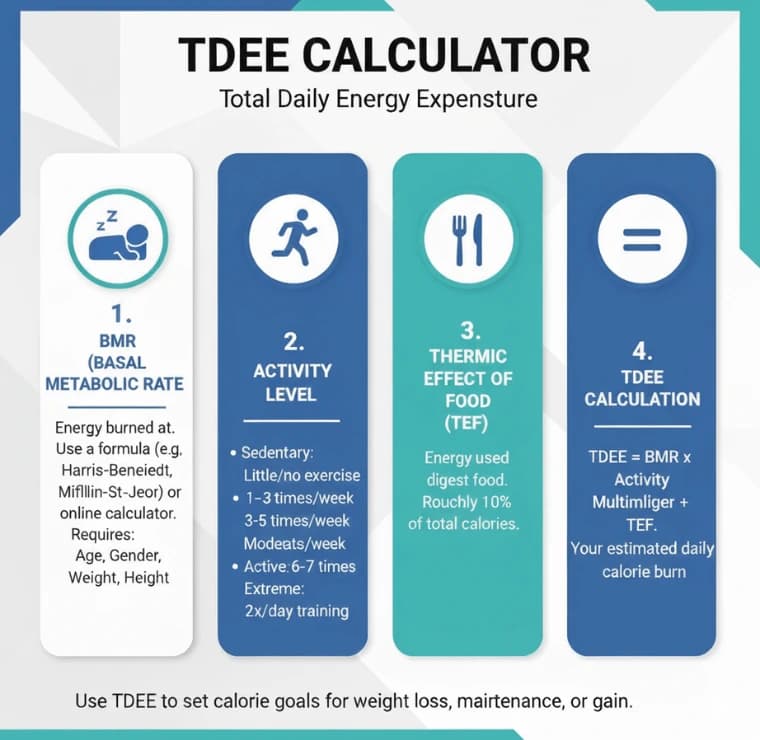
- It combines your resting metabolism (BMR) with calories burned from activity and digestion.
- Knowing your TDEE is the foundation for setting effective calorie targets for any fitness goal.
- Learn more about us and our scientific approach.
How does TDEE help with weight loss?
To lose weight, you must consume fewer calories than your body burns, creating a "calorie deficit." Your TDEE is your baseline calorie requirement. By eating consistently below your TDEE (e.g., 300-500 calories less per day), you signal your body to use its stored fat for energy, leading to sustainable weight loss.
Is TDEE better than just counting calories?
TDEE gives context to calorie counting. While counting calories tracks what you eat, your TDEE tells you *how many* calories you should be eating. Without knowing your TDEE, calorie counting is just guesswork. Using your TDEE provides a personalized, scientific target that makes your efforts far more effective.
How to Calculate Your BMR Manually
The most robust and universally acclaimed formula in modern nutritional science is the:
1Mifflin-St Jeor Equation
For Men:
BMR = (10 × kg) + (6.25 × cm) - (5 × age) + 5For Women:
BMR = (10 × kg) + (6.25 × cm) - (5 × age) - 161Example Calculation:
If you're a 30-year-old man, weighing 70 kg and 175 cm tall:
BMR = (10 × 70) + (6.25 × 175) - (5 × 30) + 5 = 1,661.25 kcalThis means your body burns about 1,660 calories per day just surviving at rest.
BMR vs. TDEE: What's the Difference?
While BMR is your energy at complete rest, TDEE accounts for your entire physiological day. It's the metric you should actually use for setting calorie targets.
| Term | Meaning | Movement? |
|---|---|---|
| BMR | Energy your body burns at pure rest | ❌ |
| TDEE | Total energy burned across 24 hours | ✅ |
The Energy Equation
Your BMR
Calories burned at rest
Physical Activity
Exercise & daily movement
Thermic Effect of Food
Calories used to digest meals
Your TDEE
Total energy baseline
Key Takeaways
- BMR is your body's energy baseline.
- Calculating it helps you control weight and nutrition effectively.
- Combine your BMR with your activity multiplier to find your TDEE.
- For optimal results, use our integrated automated calculators.
Customize Your Goal
Use your TDEE to create a science-backed plan for your specific fitness objective.
Lose Fat
To burn fat, you need to consume fewer calories than you burn. A calorie deficit signals your body to use stored fat for energy.
Eat 15-20% below your TDEE
Maintain Weight
To maintain your current weight, you need to balance your calorie intake with your expenditure. This is your TDEE.
Eat at your TDEE
Build Muscle
To build muscle, you need to provide your body with extra energy and protein for growth. A calorie surplus is key.
Eat 10-15% above your TDEE
How to Adjust Calories for Your Fitness Goals
Your TDEE is your starting line. Here's how to cross the finish line, whether you're aiming for fat loss, muscle gain, or maintenance.
Calorie Adjustments at a Glance
| Goal | Recommended Adjustment | Example (2,500 TDEE) |
|---|---|---|
Fat Loss | Subtract 300–500 calories (15-20% deficit) | 2,000–2,200 kcal/day |
Maintenance | Eat at your TDEE | 2,500 kcal/day |
Muscle Gain | Add 250–500 calories (10-15% surplus) | 2,750–3,000 kcal/day |
Pro-Tips for Success
Be Patient & Consistent
Stick to your plan for 2-4 weeks before making big changes. Results take time.
Track Your Progress
Weigh yourself 3-4 times a week under the same conditions and take the weekly average. Adjust calories by 100-200 if needed.
Listen to Your Body
If you feel constantly fatigued, your deficit might be too aggressive. Slow and steady wins the race.
Our calculations are based on the Mifflin-St Jeor formula, trusted by nutritionists.
Why Choose TDEE Calculator
We've built a tool that is not only accurate but also a joy to use.
Fast & Lightweight
No ads, no lag, no distractions. Get your results instantly without unnecessary waiting.
Privacy-Focused
No signup required. Your data is stored locally in your browser and never sent to our servers.
Smart Macros Calculation
Go beyond calories with a personalized macronutrient plan to support your specific goals.
Works on All Devices
Engineered for speed. Get your results instantly on any device, from mobile to 4K displays.
Based on Scientific Formulas
Leveraging scientifically-validated formulas for BMR and TDEE results you can trust.
100% Free
All features are completely free to use. No hidden costs or premium tiers.
Activity Multiplication Factors
Your BMR is multiplied by an activity factor to determine your TDEE. The more active you are, the more calories you burn.
Calories vs. Macros
While calories determine weight gain or loss, your macronutrient breakdown determines your body composition — the ratio of muscle to fat.
Protein
The building block for muscle. Essential for repairing tissues and preserving lean mass, especially in a calorie deficit. It is also highly satiating, helping you feel full.
Primary Sources
Meat, poultry, fish, eggs, dairy, legumes, tofu, and protein powder.
Carbohydrates
The body's primary fuel source. Carbs provide the energy needed for high-intensity workouts and daily brain function. Complex carbs offer sustained energy.
Primary Sources
Oats, rice, potatoes, bread, pasta, fruits, and vegetables.
Fat
Crucial for hormone production, vitamin absorption, and brain health. Healthy fats are a vital part of any diet, but are the most calorie-dense macro.
Primary Sources
Avocado, nuts, seeds, olive oil, and fatty fish like salmon.
The Metabolic Consensus
TDEE (Total Daily Energy Expenditure) is the final sum of four distinct biological processes. Understanding these components is essential for body composition mastery.
Adaptive Thermogenesis: The Hidden Variable
Your body is a survival machine. When you enter a calorie deficit, your TDEE is not static. It down-regulates to preserve energy. This is why standard calculators often fail after 8-12 weeks; they don't account for the body's adaptive efficiency. Our reports help you monitor these shifts.
Protein Synergy
Metabolism isn't just about calories. The thermic effect of protein is nearly 3x higher than carbohydrates. By optimizing the "macro-quality" of your TDEE, you can increase your calorie burn without extra movement.
Precision Scaling
Weight loss isn't linear. Our system provides a 7-day metabolic exit strategy, showing you exactly how your maintenance needs will evolve as your body composition changes.
Frequently Asked Questions
Common questions about TDEE, BMR, and how to use your calorie results.
Peer Reviewed Standards
Energy estimations provided by tdeechecker.com are based on mathematical anthropometric data. Individual results may vary based on hormonal health (thyroid, cortisol), pharmaceutical influence, and muscle density. Always consult a clinical dietitian before starting a chronic calorie deficit exceeding 25% of your maintenance baseline.